3D Modelling Jedi Ritter / Jedi Knight
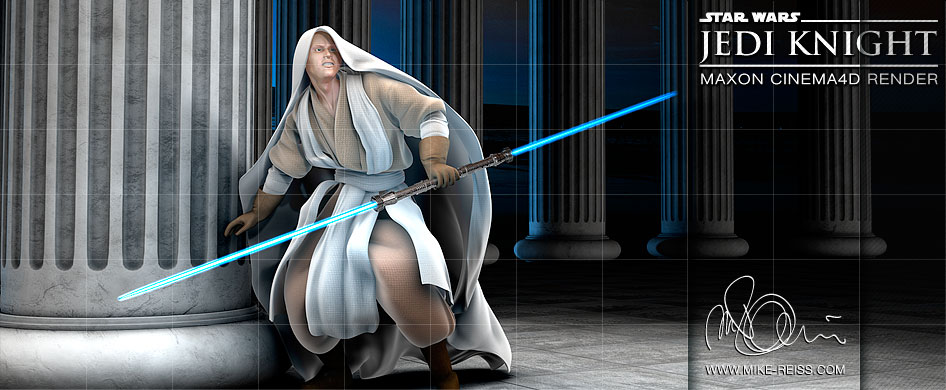
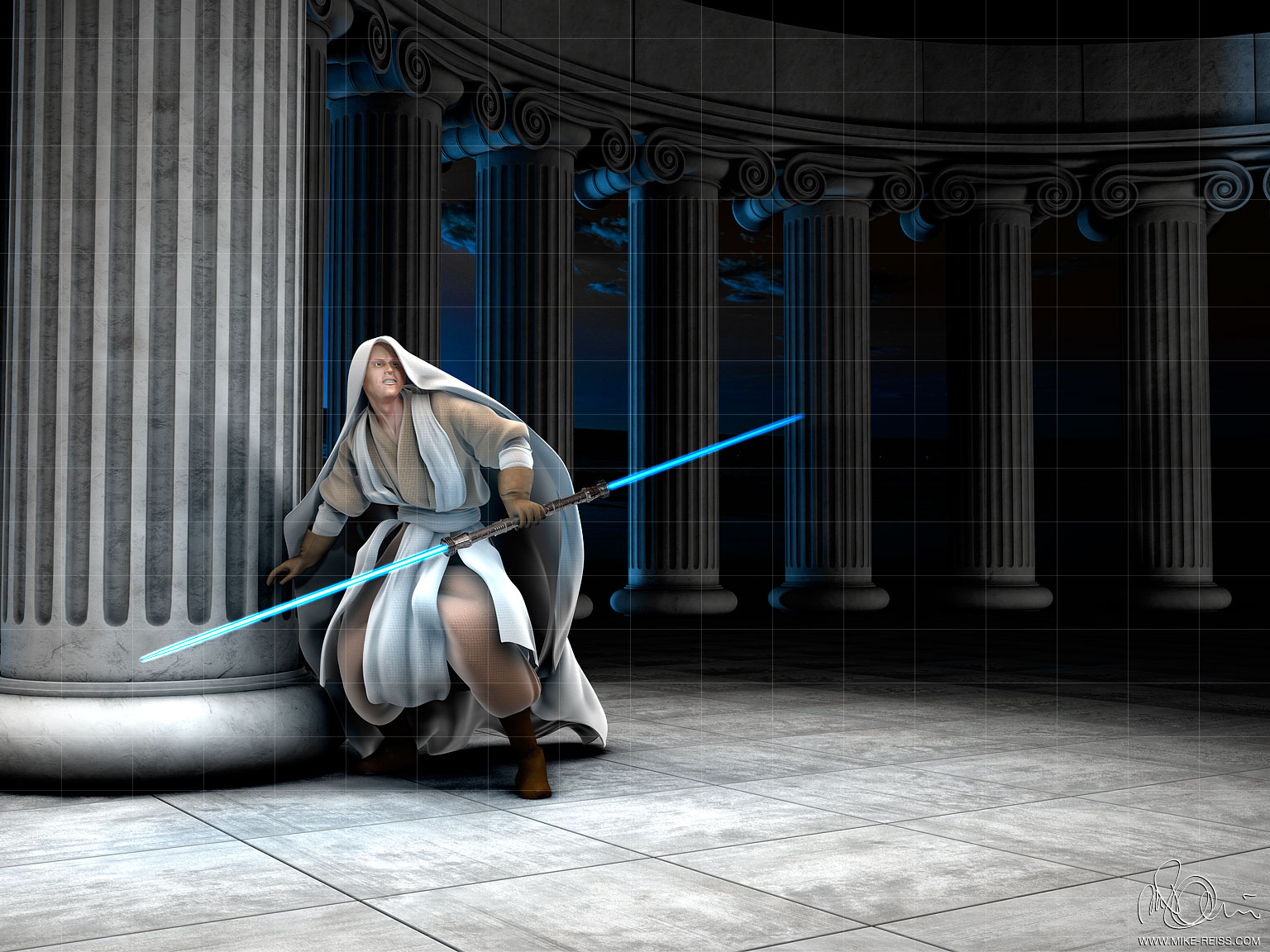
Die Säulen und der Großteil des Jedi-Ritter wurden mittels Hypernurb-Technik erzeugt. Die Kleidung (Mantel, Umhang, Gürtel) sind mit Dynamics-Objekten in Maxon's Cinema4D erstellt worden. Das Lichtschwert wurde aus Standard-Polygonen modelliert. Die Säulen wurden mit sehr viel Detailarbeit erstellt.


Lichtsystem des Tempels / Lighting of Temple
Die Szenen-Ausleuchtung wurde mittels Standard-Lichtquelle realisiert. Wobei die Lichtquellen in einer Matrix angebracht wurden, um die gewünschte "Radiosity" - Optik zu erzielen. Dadurch wurde ein Licht/Schattensystem entwickelt welches sonst nur durch den Einsatz echter Global Illumination (GI) erreicht werden kann.

StarWars Jedi Knight 3D Model Render / Jedi Ritter Modell in Cinema4D Modo Lightwave Zbrush 3DSMax Maya
StarWars Jedi Ritter mit Lichtschwert in Tempel als Modell und Texturen - gerendert in Cinema4D
StarWars Jedi Knight with light sabber in temple as 3D Model (Mesh, Wireframe) and Textures - Render in Cinema 4D

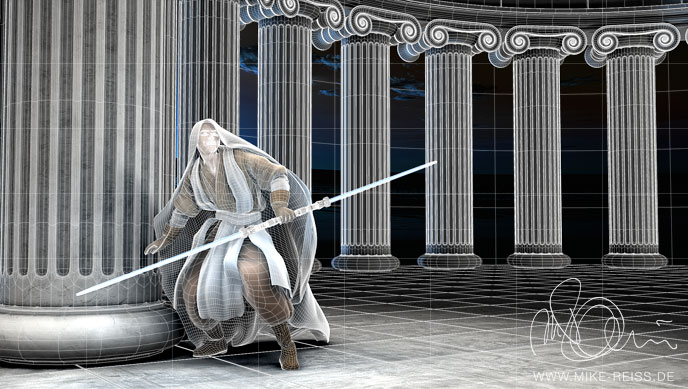
Jedi Ritter 3D Wireframe Modell Render / Jedi Knight Drahtgitter

Jedi Ritter 3D Wireframe Modell Render / Jedi Knight Drahtgitter

Jedi Ritter Pressetext
Die Jedi verfügen über übermenschliche Fähigkeiten. Diese erhalten sie durch eine Kraft, die als Die Macht bezeichnet wird. Die Filme erhalten den handlungsbestimmenden Konflikt aus dem Einsatz und dem Missbrauch dieser Macht durch die Jedi und ihre Antagonisten, die Sith (siehe unten). Setzt ein Jedi die Macht im Zorn ein – auch im Glauben, dass dies im Rahmen einer guten Sache geschehe – so besteht die Gefahr, dass er auf die dunkle Seite der Macht wechselt und dem Bösen verfällt.
Die Jedi handeln nach einem Kodex, der ihnen helfen soll, im Einklang mit der Macht zu leben und nach ihrem Willen zu handeln, sie nicht zu missbrauchen und somit nicht auf den Pfad der dunklen Seite der Macht zu gelangen. So schreibt der Kodex vor, dass die Jedi Friedenswächter der Galaxis seien und ihre Kraft und Macht nur der Verteidigung und dem Schutz anderer zu dienen hat. Außerdem haben Jedi über ihren eigenen Gefühlen zu stehen. Dies bedeutet keinesfalls, emotionslos zu handeln, die Jedi dürfen ihre Entscheidungen lediglich nicht aus Zorn, Trauer, Furcht oder Freude treffen, sie müssen objektiv entscheiden, um dem Frieden zu dienen und ihn zu bewahren. Die Stärke der Jedi basiert auf den drei Säulen Disziplin, Wissen und der Macht. Die Jedi-Ritter des Alten Ordens führten zudem ein klosterhaft keusches Dasein, während die Jedi-Ritter des Neuen Ordens (unter Luke Skywalker) heiraten und Kinder kriegen durften. Der in den Filmen geäußerte Gruß der Jedi, der vor allem beim Abschied gebraucht wird, lautet: „Möge die Macht mit dir sein“ (im Original: „May the Force be with you“) Das Phänomen der Macht wird in den Episoden IV-VI nicht näher definiert. Die Macht gilt dort - in Anlehnung an fernöstliche Prinzipien wie etwa das Chi - als etwas, das alles Leben und auch die unbelebte Natur miteinander verbindet, ohne einer rationellen Erklärung zu bedürfen. Jedes Kind kann mit der „Macht“ gesegnet sein und muss nicht vererbt werden. In den drei neueren Filmen werden die Midi-Chlorianer eingeführt; symbiotisch arbeitende Mikroorganismen, die als kommunikatives Bindeglied zwischen Macht und Lebewesen fungieren (die Midi-Chlorianer-Konzentration im Blut gibt auch an, ob und wie viel Machtpotenzial man besitzt). Die typische Waffe eines Jedi ist das Lichtschwert. Jeder Schüler lernt in seiner Ausbildung, wie ein Lichtschwert zusammengebaut wird. Im Griff des Lichtschwertes befindet sich ein machtsensitiver Kristall. Diese Kristalle werden nur auf dem Planeten Ilum in bestimmten Höhlen gefunden. Wenn ein Jedi-Schüler sein Lichtschwert empfangen soll, reisen er und sein Meister zu diesem Planeten, wo der Schüler dann allein in die Höhle gehen muss, um den für ihn „bestimmten“, Kristall zu finden. In dieser Höhle werden dem Schüler seine tiefsten Ängste, in Form von Halluzinationen, entgegentreten. Dies ist die letzte Prüfung, bevor der Schüler sein Lichtschwert empfängt und zum Padawan wird. Aus dem Lichtschwert kommt ein gebündelter etwa ein Meter langer Energiestrahl, der, durch einen Knopf kontrolliert, aus einem handlichen Griff austritt. Es ist auch von Nichtjedis benutzbar, wie Han Solo es in Episode V demonstrierte, als er den Bauch eines toten Tiers aufschlitzte, um Luke in dem warmen Kadaver vor dem Erfrieren zu retten.
Einige Jedi jedoch haben den Aktivierungsknopf ins Innere ihres Schwertes gebaut, damit die Waffe nur von Machtbenutzern verwendet werden kann.
Jedi Knight Press Release
The Jedi initially formed at approximately the same time as the Old Republic, 25,000 years before the time frame of the movies. However, soon after its formation, several Jedi left the order to follow the path of the Dark Side, the first of many schisms. The Jedi Order was ruled by a board of 12 members called the Jedi Council, located on the planet of Coruscant before being destroyed by Emperor Palpatine. The council represented a gathering of great minds which acted as a governing body for the order as well as a martial advisory board for the Old Republic Senate.
[edit] Expanded Universe Within the Expanded Universe of Star Wars media, the primary Jedi Council on Coruscant is the most dominant of a number of Jedi governing bodies. At one point approximately 4,000 years prior to the movies, there was also a Jedi council on Dantooine. After the events in Episode 6, Luke Skywalker eventually reestablishes the Jedi Order and creates something called the Masters' Council. During times of great danger, the Jedi engaged in direct democracy through massive gatherings called conclaves, at which they discussed issues and came to decisions. The Sith trace their roots back from heretical Jedi who followed the path of the Dark Side towards the homeworld of the Sith race.
This Sith Empire invaded the Old Republic 5,000 years before the events of the movies in what was known as the Great Hyperspace War.
Over time, the Dark Jedi and the Sith intermingled, until eventually the word Sith stopped referring to the race but rather the ideology of the Dark Jedi, and the Sith began to come from various races and planets united by the goal of eradicating the Jedi and the pursuit of power through the Dark Side.
[edit] Jedi ranks Members of the order progress through four to six tiers of rank, at times referred to as levels. * Jedi Youngling : A Jedi Youngling is a Jedi learning to control the force and how to wield a lightsaber. The title of Jedi Youngling is the first part of a Jedi training. Younglings were seen training with Jedi Grand Master Yoda in a scene from Star Wars Episode II: Attack of the Clones.
* Jedi Padawan: A Youngling that successfully completes their respective level of training undergoes Padawan apprentice training under the tutelage of a Jedi Knight or Jedi Master. As a rite of passage and the final test before the trials to knighthood, Padawans must build their own lightsabers. In the Old Republic, male Human Padawans usually wore braids in their hair that were removed upon attaining knighthood.
* Jedi Knight: Disciplined, experienced Jedi may become full-fledged Jedi Knights once they have completed "the trials" that test candidates' skills, knowledge, and dedication. The three tests are usually known as The Trial of Skill, The Trial of Spirit, and the Trial of Knowledge. In Return Of The Jedi, Master Yoda gives his apprentice Luke Skywalker the trial of confronting Darth Vader for a second time so he might become a full-fledged Knight. Occasionally, performing an extraordinary (usually heroic) act can earn a Padawan learner Jedi Knight status, such as when Obi-Wan Kenobi defeats the Sith Apprentice Darth Maul. Or in the case of Anakin Skywalker who defeats Sith Apprentice Asajj Ventress.
* Jedi Master: A Jedi Knight may become a Jedi Master after successfully training a Padawan learner to Knight status. Though this is the most common manner, it is not always the case. If the council sees that a Jedi Knight has become more powerful and has gained more knowledge and discipline in the Force, then they can be nominated by one or more council members to take the trials again.
* Jedi Council Member: When a Jedi Council Member vacates its seat, the council looks for an exemplary Jedi Master to fill the empty position. Presiding Council Members elect prospective candidates when openings become available. According to the Dorling Kindersley guide to Star Wars Episode I: The Phantom Menace, some members were permanent members (like Yoda and Mace Windu), while the rest served limited terms, after which they stepped down and another member would be elected to the Jedi Council. With the exceptions of Anakin Skywalker and Ki-Adi Mundi, who was the only Knight on the Council for a short period of time before becoming a Jedi Master, all council members require the status of Jedi Master prior to entering the council.
* Jedi Grand Master: Formally "Grand Master of the Jedi Order," only the highest-ranking Jedi Masters take the title. The title of Grand Master/Supreme Master is merely a theoretical title given by Jedi Masters to a certain Master who has been most wise among other masters in the council, as with Master Yoda. The Jedi Grand Master does not enjoy any greater privilege than any council members because the council members also have a vote in any issues presented by the council. The Grand Master was apparently the "first among equals" of the Jedi High Council, or the later Masters' Council. Yoda and Luke Skywalker (in the expanded universe) are Grand Masters.
Tags
StarWars, Jedi, Ritter, Halle, Säulen, Marmor, Lichtschwert, Mantel, Nacht / Jedi, Knight, Hall, Columns, Marble, Lightsaber, Cloak, Night, Maxon Cinema 4D, Adobe Photoshop, C4D Shader, Texturen, Tempel, Halle, griechische & römische Säulen, Antike, Granit, Kledung, SCIFI, Science Fiction, Lucas, Krieg der Sterne, Luke